What role does narrative play in the creation of your products, and how do you ensure it resonates with the users?
Storytelling plays a fundamental role in the creation of our design products, as it allows us to communicate a story and evoke emotions through the product, transforming it from a mere functional object into an engaging experience for the end user.
In a world where communication increasingly happens through images, beauty in design can no longer be conceived as just the traditional balance between form and function inherited from modernism. Instead, beauty must emerge from the harmony between function and the ability to communicate through form, establishing a simultaneous dialogue with both the mind and body of the user.
Our products exhibit two forms of communication: extrinsic and intrinsic. ‘extrinsic narrative’ involves the narrative we build around the product: its story, the creative process, technical innovations, chosen materials, and the cultural values we aim to represent. ‘Intrinsic narrative’, on the other hand, refers to the poetic content inherent in the object itself, the set of meanings that an individual perceives through the work, arising from a personal dimension of experiences, analogous to the interpretation of a work of art, which exists to express ideas or values capable of influencing the spirit of the observer.
For us, poetic content represents the essential narrative, as it is where the core communication of the object resides. It is the element that evokes residual images in the user’s mind, around which personal storytelling develops, thus creating new memories.
Narrative allows us to create an emotional connection between the product and the user, transforming the product from a mere object into something meaningful. It enhances the product, making it perceived as something valuable and special.
To ensure that narrative resonates with users, it is crucial to maintain the authenticity of the message. We target an audience that seeks beauty, loves design, and generally looks for a deeper meaning in things. The perception of the poetic content of the narrative is guaranteed by the inevitable individual experience of users, who, through automatic and unconscious interpretation, end up attributing a personal meaning to the object. This meaning originates and becomes part of their lived story. Such meanings are not universal; their perception is subject to each individual's inner nature. Mental preconceptions and experiences shape perception, implying that each person can see only what they know, in the way they know it.
How does the 'eidetic dream' virtual gallery enhance the experience of your products for visitors?
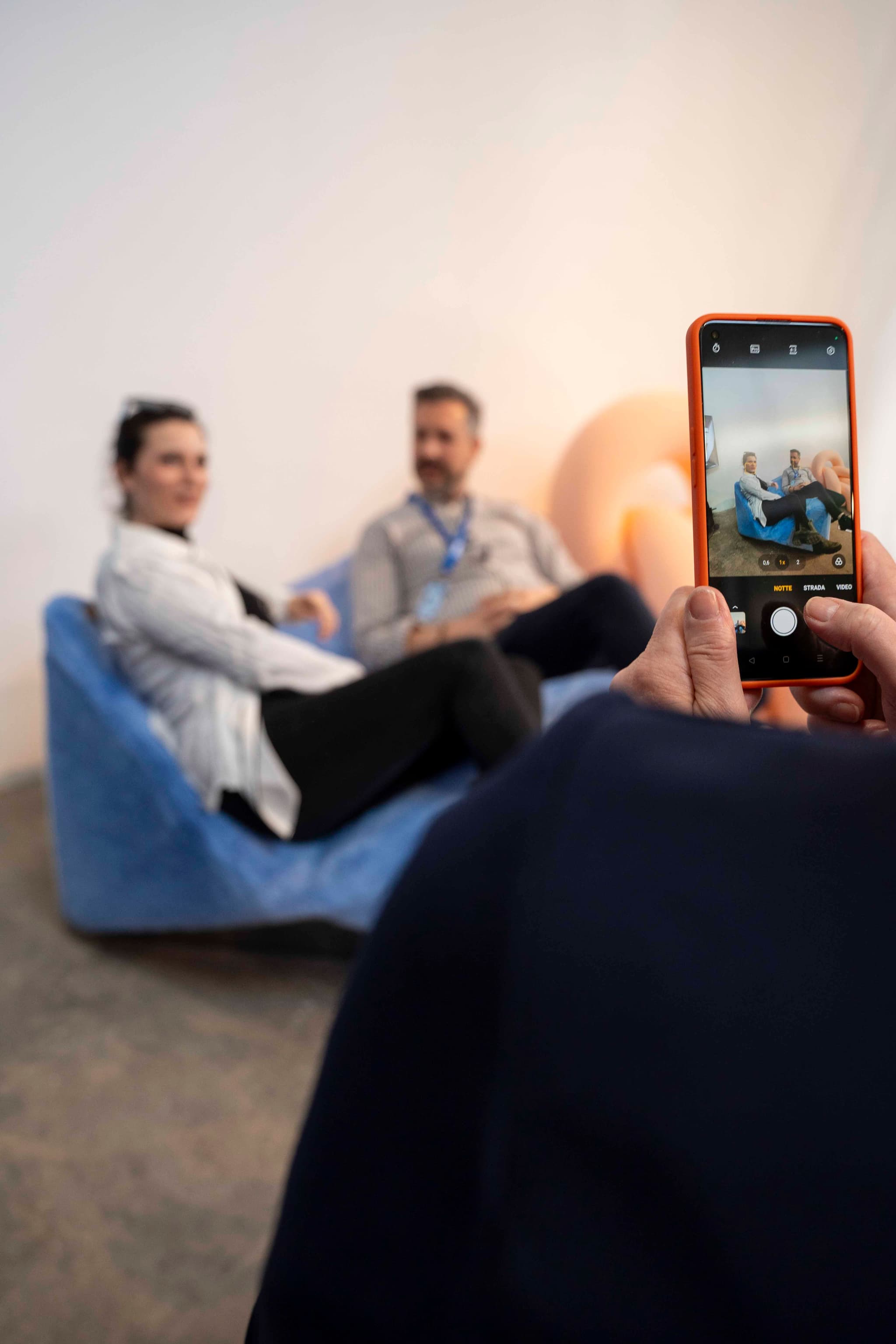
Eidetic Dream was created for the Isola Design Gallery exhibition during Milan Design Week 2024, with the primary goal of allowing students and design enthusiasts from around the world, who were unable to attend in person for various reasons, to experience our products from anywhere. A secondary goal is to enrich and amplify the physical experience for those who were able to attend the event.
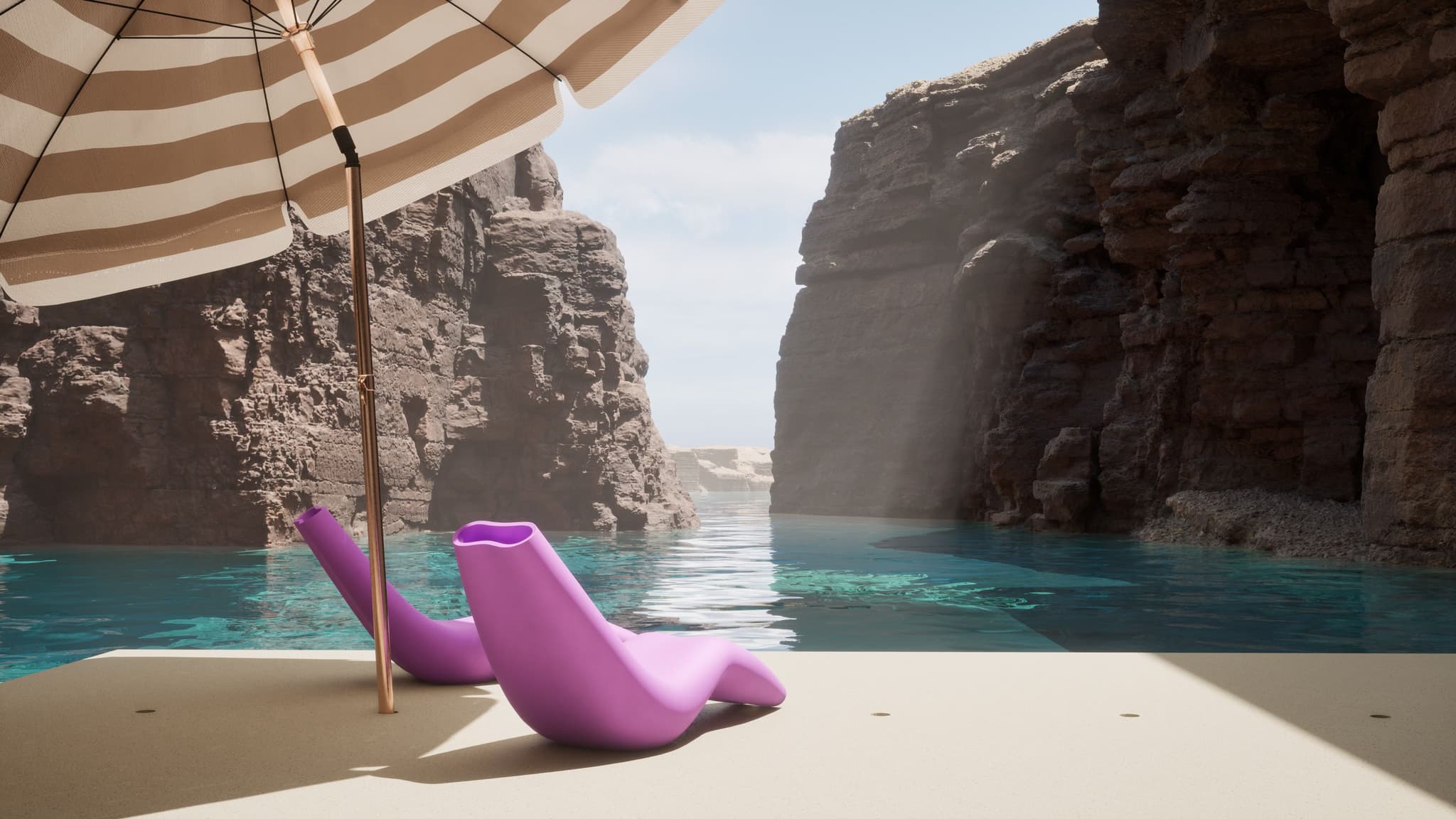
It is an immersive virtual space characterized by hyper-realistic graphics, where design products and architecture merge in a symbiotic relationship, transporting visitors to environments that convey and reinforce the poetic content of the displayed objects.
The Eidetic Dream virtual gallery is freely downloadable from our website and can be visited via a joypad or mouse and keyboard interface (a VR headset version will be available soon). This project stems from our desire to explore the possibilities offered by the Unreal Engine 5 graphics engine. All stages of realization, from design to final programming, have been managed entirely within our studio for the first time, representing a challenge as complex as it is exciting.
How do you choose materials for your products, such as the core of curved metal and various upholstery options for the Sweep2 armchair?
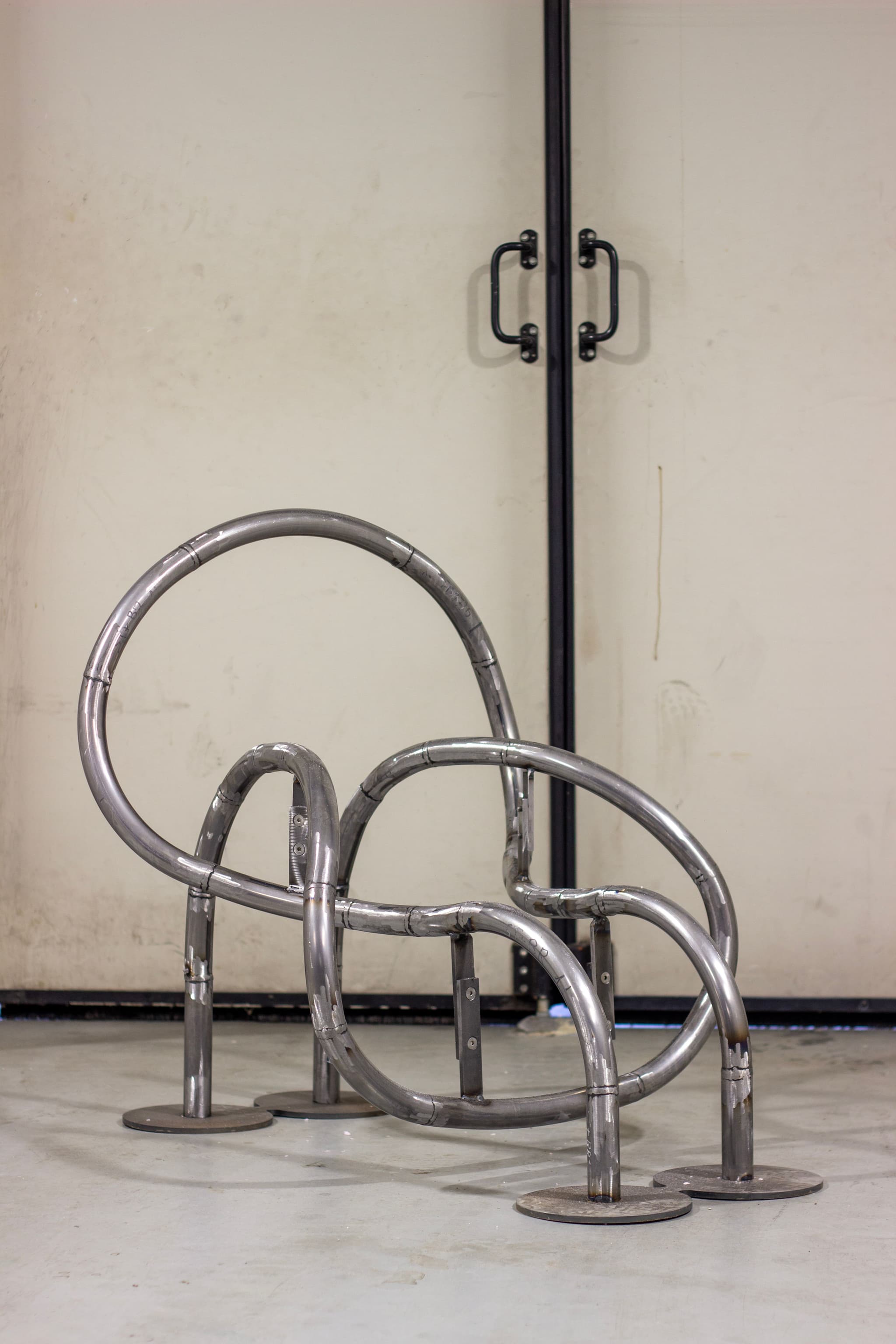
Sweep2 is an armchair characterized by an extremely bold and minimal aesthetic. A single geometry, intersecting with itself, creates a shape that fulfills all the typical functions of an armchair: backrest, armrests, seat, and base.
When designing a distinctive seating piece like Sweep2, material choice and construction techniques become crucial to achieving the right balance between aesthetics and functionality. Defining structural elements and selecting finishes involves a process that considers several factors: aesthetic coherence, technical feasibility, structural strength, comfort and ergonomics, and durability.
Our research has not been limited to the poetic content embedded in the form. We did not want Sweep2 to exist solely as an impossible object, but also focused on its actual feasibility and user experience. We wanted a geometry as unique as this one to be surprisingly enveloping and comfortable, like a hug.
The metal structure of Sweep2 enables a fluid and harmonious silhouette while ensuring necessary solidity. The use of expanded foams with varying densities provides the right support in key areas and contributes to the overall comfort that is like the the feeling of a hug. The choice of upholstery is crucial to defining the final look and tactile sensation: Lycra and wool, each for different reasons, best meet the technical and sensory needs, perfectly interacting with the emotional image of the object.
Can you detail the process and benefits of using lycra and wool upholstery in terms of comfort, durability, and maintenance?
We enjoy working with wool, both for our interior and product projects, because it is a completely natural fiber with an extremely sophisticated appearance that provides comfort and warmth to seats, sofas, and cushions.
The most fascinating physical characteristic for us is its natural comfort derived from its excellent thermal regulation capability, which allows it to retain heat in cold months and stay cool in warmer ones. There are so many color and texture varieties that make it an extremely versatile material for interior design.
Interest in using Lycra, on the other hand, arose due to its exceptional properties, making it ideal as upholstery for upholstered furniture and seating. Thanks to its elasticity, Lycra can adapt to complex shapes, ensuring a smooth, glossy, and uniform finish while remaining soft and flexible to the touch.
Its maintenance is simple, as it can be easily washed in a machine or treated locally for small stains. Additionally, specific treatments can enhance its resistance to dirt and stains, promoting durability over time.
The choice of these two materials depends on the specific needs of the project: whether related to form, tactile experience, or aesthetics, we want each item to be consistent with its nature and the message we wish to convey.
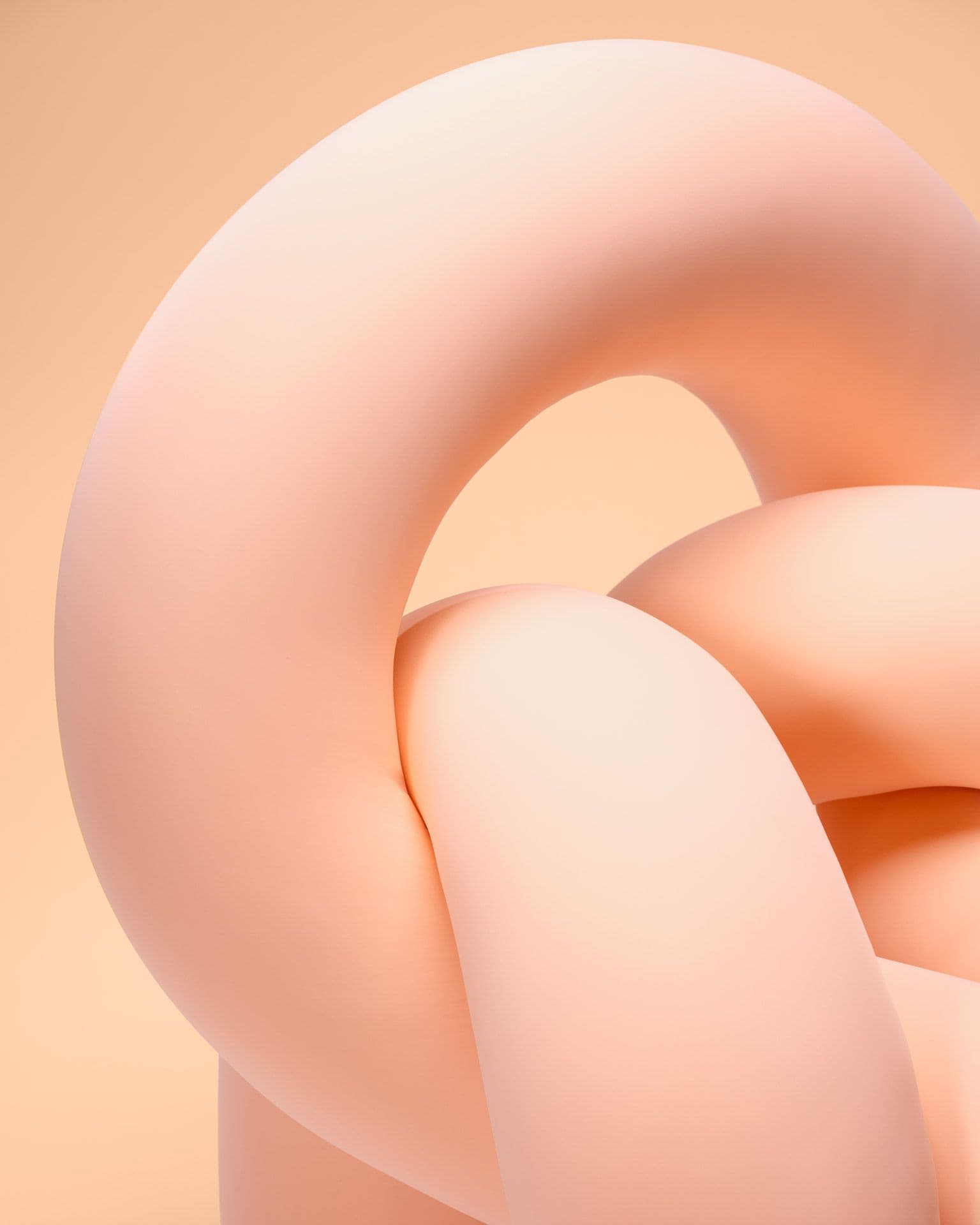
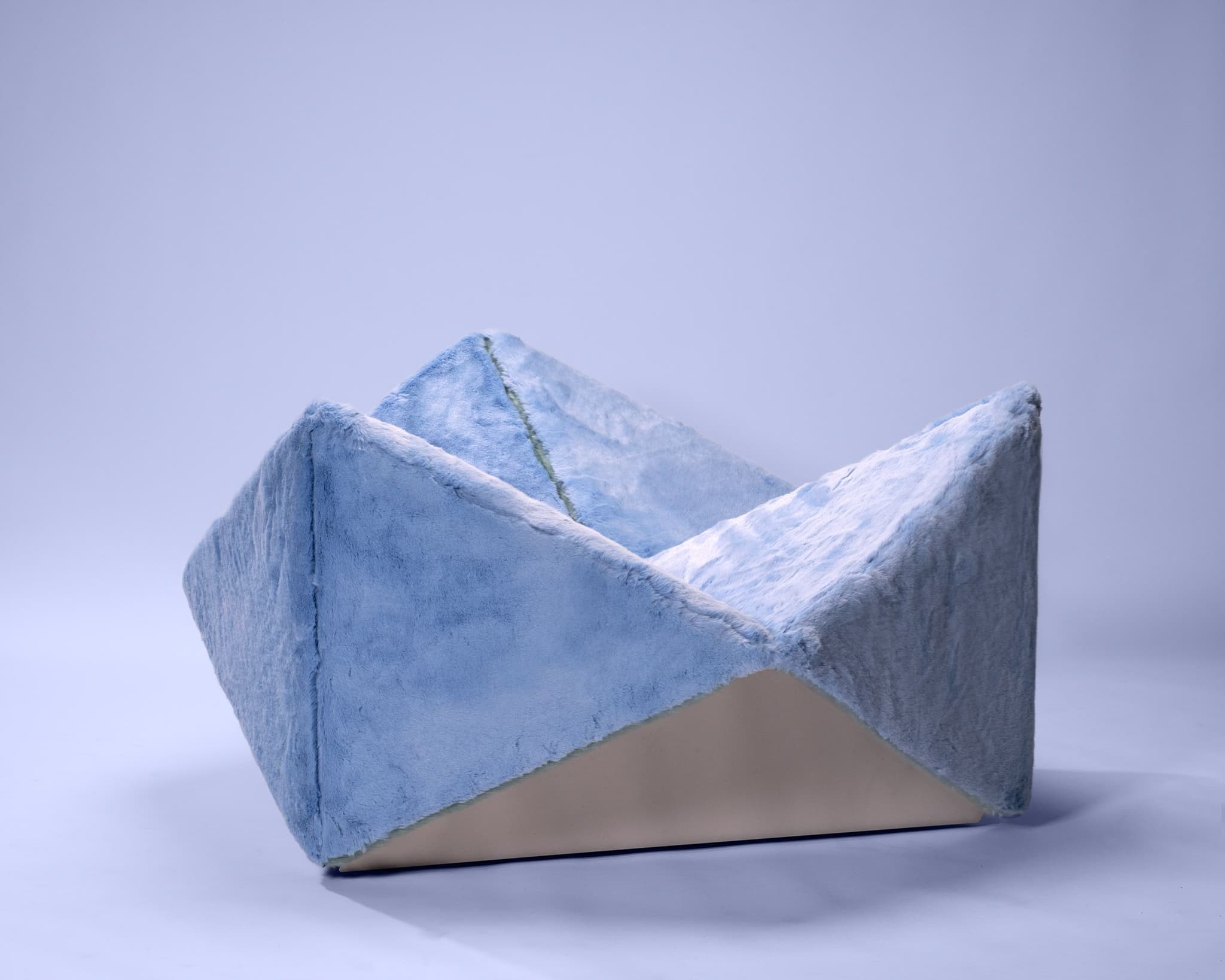
How do you balance the tactile and aesthetic properties of eco-friendly fur and faux leather in your customisable finishes for the Dionea seat?
Dionea is a product with an elusive definition; we call it the 'quasi chair.' It is surprising how many ways it can be used, as well as the ease with which it can switch from one finish to another, with the lightness and simplicity typical of play.
Such a mutable object requires particular attention to balancing aesthetics and tactile sensation during design. Each material used must have specific characteristics in terms of touch, aesthetics, and functionality. These materials can be combined in contrast or complementarity, creating a varied tactile and material kaleidoscope adapted to the user’s needs.
Our faux fur, sourced from high fashion, guarantees exceptional quality and durability, offering a sensation of warmth and enveloping softness without the ethical concerns associated with animal fur. Its generally luxurious and appealing appearance is lightened by the product's unique geometry and bold, contemporary colors, collectively transforming Dionea into a statement piece capable of attracting attention and becoming the focal point of the space.
In its eco-leather configuration, Dionea presents itself as a versatile and practical solution, offering a cruelty-free alternative to natural leather while maintaining refined and modern aesthetic and tactile properties. The smooth and even surface conveys a sense of order and modernity, characterized by freshness and cleanliness. Aesthetic, synthetic leather is extremely versatile, offering a wide range of colors, finishes, and textures that provide visual depth. One of the qualities we most appreciate in this material is its ability to actively respond to user contact, warming up with body heat and thus offering an almost sensual tactile sensation.
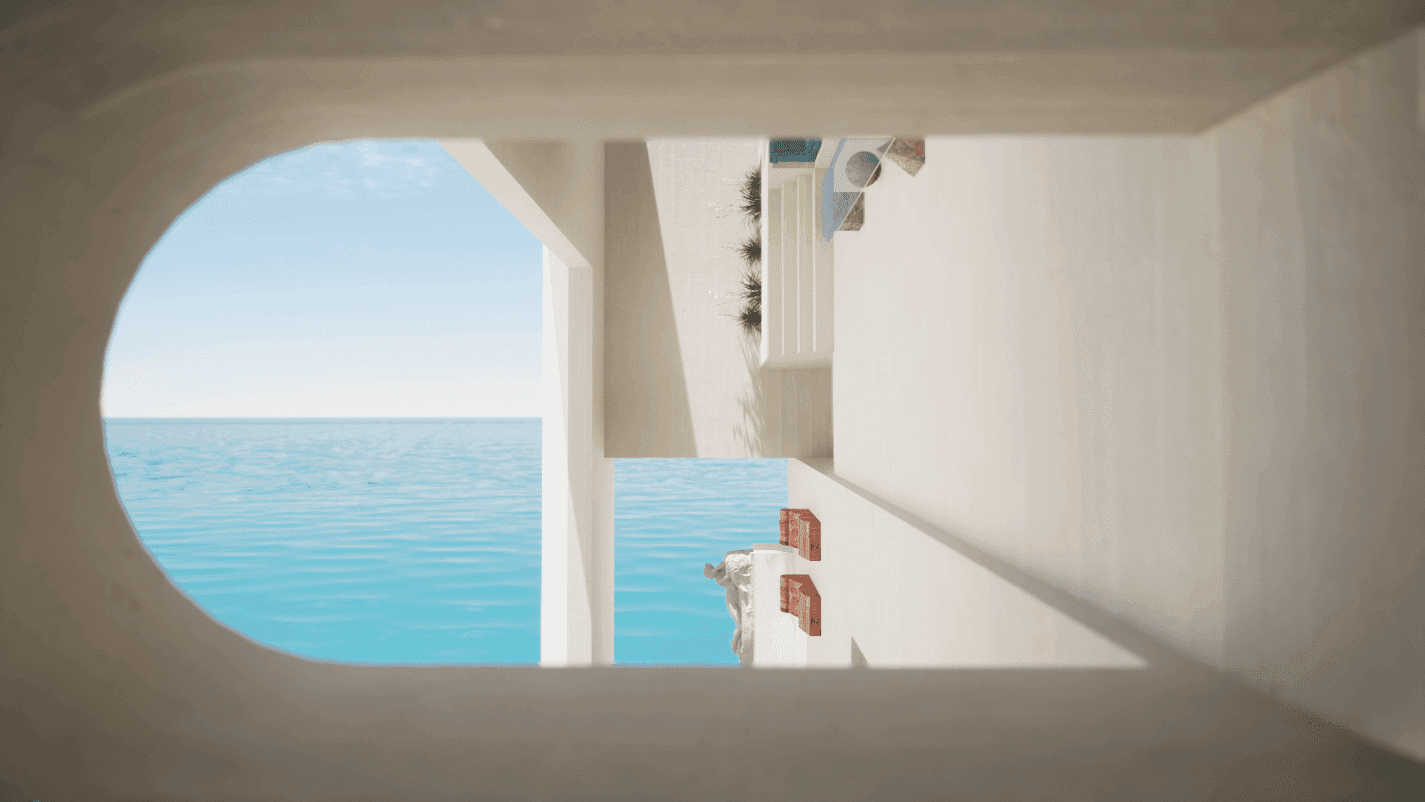
How does the Metacave project reflect your vision of merging natural and digital environments?
MetaCave was our first exploration of the metaverse through an architectural project developed within an advanced virtual reality graphics engine like Unreal Engine 5. Using this tool, with its unprecedented level of realism, allows us to create an immersive architectural experience where natural and digital environments interact through virtual reality (VR), augmented reality (AR), and mixed reality (MR), providing an authentic sensory experience for the user.
The project is characterized by crossing the boundaries of contrasts, classical dualisms dialogue through the project and merge into one essence:
- nature and landscape / architecture
- human / digital
- interior / exterior
- formal minimalism / poetic objects
- physics / metaphysics
The perception of space as we know it is turned upside down by the inner gravity of the metacave, which offers glimpses between indoor-indoor and indoor-outdoor spaces never before experienced. Ceilings that change into walls, vertical horizons, interiors that became exteriors, are just some of the perceptual twists that can be experienced in the project.
The perceptual experience we have as individuals in the physical natural world can, in certain contexts, be reproduced in the metaverse through digital simulation. This simulation generates a real experience for the user as it is interpreted at a sensory level, becoming increasingly assimilable and sometimes indistinguishable from that of the physical natural world.
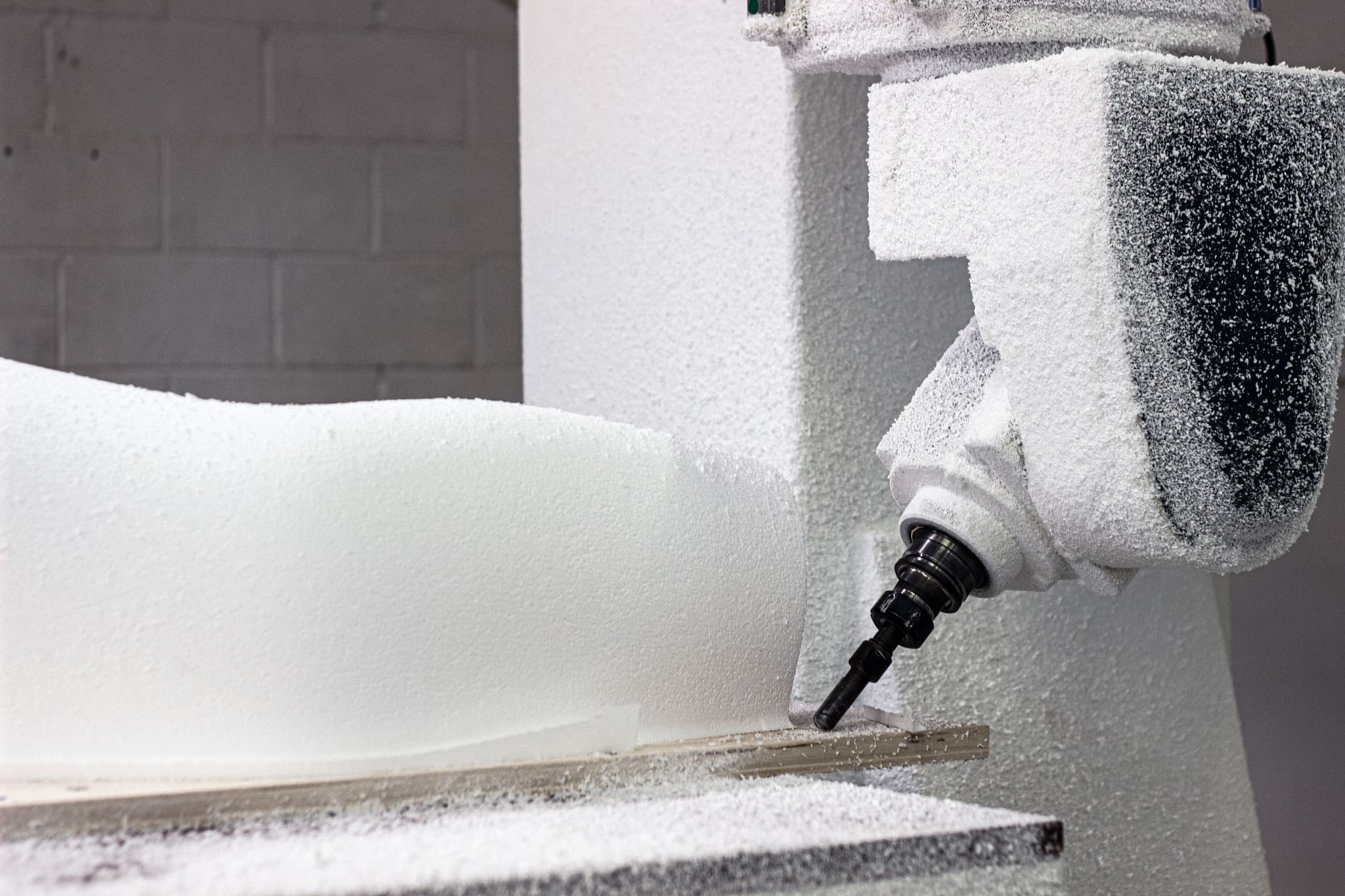
How do you incorporate digital fabrication methods, such as 3D printing or CNC machining, into the production of your furniture pieces?
Our studio has been working in the interiors and contract furniture sectors for over a decade. This has allowed us to develop a solid network of master craftsmen and suppliers, with whom we have experimented with numerous processing techniques and finishes, using a wide range of materials.
For years, we have used 3D printing and CNC machining as fundamental tools to achieve the design and production levels we aim for. Integrating digital fabrication with CAD/CAM tools and 3D simulation allows us to optimize projects, improving both aesthetics and functionality. This approach minimizes material use and production times, enhancing overall efficiency and reducing environmental impact.
3D printing represents a revolution in the idea development process, allowing us to speed up prototyping times. It enables us to test design ideas and assess product ergonomics, with the possibility of making modifications before finalizing and producing. Additionally, it allows for the creation of organic shapes and complex geometries that we can use as unique pieces, components of furniture, or molds for further processing. Being an additive process, prototyping is much more efficient compared to subtractive processes, resulting in a positive impact on both costs and the environment.
CNC machining is now essential for the production of furniture elements. It guarantees precision even with large dimensions and curved or complex shapes. In situations such as the prototyping and production of the BDSM sun lounger, CNC has allowed us to operate on a scale that is difficult to achieve with 3D printing. Many of our suppliers use CNC, enabling us to work with a wide range of materials, from fine woods to metals, as well as foams, plastics, and modern composite materials. This also ensures precision in the assembly of different materials and components.
In this way, we ensure efficiency, precision, and tailor-made customization for our products and clients. The key to our approach lies in the balance between technological capabilities and a clear design vision, where technology becomes a means to express creativity, functionality, and sustainability in high-quality furniture design.
Can you explain how generative AI design and immersive virtual reality are integrated into your design process?
AI does not replace the role of the designer but amplifies it. As designers, we view the algorithm as an active collaborator that proposes innovative solutions and variations, which we can then refine and customize according to our artistic vision and direction. In this way, AI becomes a creative tool that expands possibilities rather than a substitute for human processes.
We specifically use this tool to optimize certain tasks, such as finalizing the rendering of our visuals, identifying alternative materials or compositions based on our 3D visualizations in interior design projects, and developing and collecting references for extremely alternative concepts.
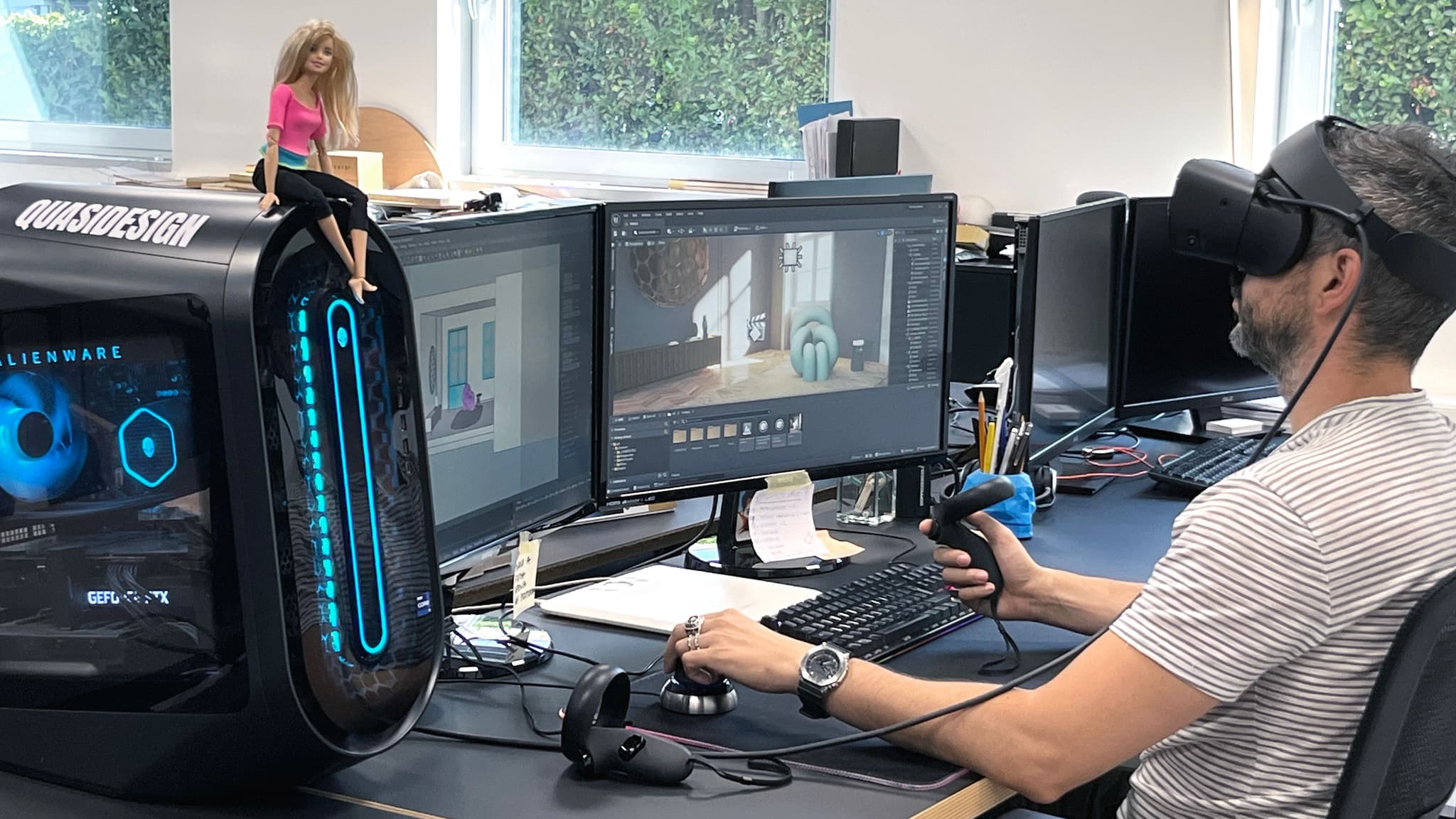
Immersive Virtual Reality (VR) provides us with the opportunity to visualize, test, and modify our designs interactively and immersively. This tool helps us assess the interaction of objects with space or entire environments realistically, allowing us to walk around the product and explore it in full scale from different angles using a VR headset, even before having a physical prototype.
This capability is not only a tool for us as designers but also for our clients, who can explore the environments or furniture we create for them, making the design process more interactive, dynamic, and participatory.
We can thus offer the client an immersive storytelling experience: the design of a residence can become more than just a living space, transforming into a narrative environment where inhabitants experience an evolving story over time. Digital elements can tell a visual story that changes with the passing hours or responds to external weather events, such as a morning with soft and intimate light or a warm and relaxing sunset. This creates a narrative experience that enhances the design and establishes an emotional and meaningful connection between the project and the user.
The integration of generative AI and VR in our work creates a highly synergistic and dynamic workflow, leading us to new levels of innovation, customization, and efficiency. The combination of these tools allows us to create furniture products that not only meet high standards of functionality and aesthetics but are also highly customized and tailored to the real needs of users.
Are there any new design fields or techniques that QDS Studio is looking to explore in the near future?
In addition to AI and VR that we already use, we are implementing Parametric Design. Through various algorithms, this approach will allow us to develop products that adapt dimensionally or formally to spaces and user preferences. Currently, we are working on a system for an adaptive table that can modify its shape, dimensions, and finishes to fit various dimensional and aesthetic contexts defined by the user.
This parametric system, combined with AI, is leading us toward Mass Customization. Through the synergy between generative algorithms, artificial intelligence, and the designer's artistic direction, we aim to create tailored products and environments for the client, optimizing both the design and production phases.
We are also working on training a custom generative AI model running Stable Diffusion locally. This model will be designed to respond more precisely to our needs and visions, thus improving the interpretation of our creative vision.