Between COP Paris and Glasgow, half a trillion tonnes of virgin materials were extracted from the Earth.
To put that into perspective, that’s the equivalent of 2.7 million Empire State Buildings and 5.5 billion Boeing 747.
It looks like we are digging the Earth empty.
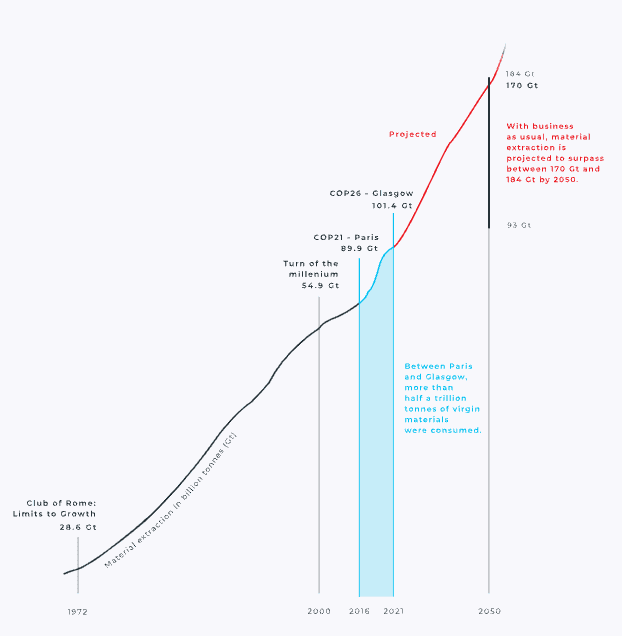
Our extractive economy consumes 100 billion tonnes of materials per year (Source)
Climate change has become a focus of sustainability discussion over the past few years, as it should be. But besides climate change, there are many other existential crises that are happening that are so dire and require our attention equally.
And among those, this massive material crisis is quietly passing under our noses for many of us. Only 9% of plastics are recycled. Close to 100M tonnes of unsold textiles are ending up in landfills. Close to 20% of unwanted clothes are burnt. Only 1% of plastic bags are recycled globally.
Materials demand is on the rise globally
In a world where economic growth is still too often equated with well-being, our thirst for materials is predicted to surge.
The numbers speak volumes: from 79 gigatonnes in 2011, the demand for materials is projected to more than double, reaching a whopping 167 gigatonnes by 2060, according to OECD research.
Yes, we are aspiring to net-zero emissions, but the current trend of material consumption suggests that we are moving in the opposite direction.
The stark reality is that production, usage, and disposal of materials already account for nearly a quarter of all global CO2 emissions. If we continue on this trajectory, our carbon footprint will only grow, shadowed by a rise in materials use.
Today, Europe's use of materials is far from circular, with many materials failing to be recycled or decreasing in value due to quality degradation.
Our recent research focused on both the volume and price of these materials, a rare approach in this field. We found that, despite the technical potential for recycling, 56% of the total value of materials is lost after a typical use cycle in Europe’s economy. This is a significant loss and one that could be minimized through the adoption of circular-economy practices.
Circular economies not only promise reduced greenhouse-gas emissions but also present an exciting business opportunity. If we were able to recycle all the lost materials, they could provide as much as 64% of EU production for the same materials today, and potentially rise to over 80% by 2050.
Shifting towards a regenerative economy
So, the path forward is clear: we must transition from a linear and extractive model to a better one.

Amazon deforestation (Source)
In the midst of this grim scenario, enter Forestwise.
Having borne witness to the devastating impacts of deforestation in Borneo, they set themselves an ambitious goal to stop deforestation and create rainforest value by commercializing valuable forest products. Their strategy is as simple as it is brilliant: empower local communities to become the custodians of their forests.
The good news is - there are thousands and millions of companies like ForestWise across the globe, as we speak, already working on low-carbon, regenerative materials. These incredible, elegant, simple solutions are all scattered around the world, waiting to be discovered and scaled.
In order to kick-start the flywheel of a regenerative economy, we propose a rather no-brainer solution at tocco:
- we find these in innovators, entrepreneurs, designers
- we gather them and shine lights on their
- and help scale their solutions everywhere
Just look around you and imagine:
- your walls don’t have to be in toxic cement and plastic, they could all be wood-based
- your clothes don’t have to be made from fossil-based synthetic fibers but seaweed fibers
Imagine if the more we produce the better it is for the biosphere.
As our materials and objects can be thrown away, got rotten, become fertilizers, and nurture the soil.
This is the world that we are working towards at tocco.earth.
References
- https://www.circularity-gap.world/2022
- https://www.oecd.org/newsroom/raw-materials-use-to-double-by-2060-with-severe-environmental-consequences.htm
- https://www.zawya.com/en/projects/industry/materials-transition-is-must-to-achieve-global-net-zero-emissions-goals-aramco-ceo-r5j8zh8h
- https://www.mckinsey.com/capabilities/sustainability/our-insights/how-a-materials-transition-can-support-the-net-zero-agenda
- https://www.mckinsey.com/capabilities/sustainability/our-insights/how-a-materials-transition-can-support-the-net-zero-agenda