
Key Points
- Made from surplus edible wafer paper (potato starch), cut to 1–1.5 cm; sheets are ~0.3–0.6 mm thin and fully water-soluble.
- Dissolves in rain, freshwater and seawater; no microplastics or toxic residues.
- Prioritises EU food-grade pigments, colourfast when wet; minor UV fading accepted.
- Packaged in recyclable/compostable kraft or sugar-cane bioplastic; moisture vs. compostability balanced.
- Scales via short Dutch supply chains; variability handled through a pastel palette; recognised by Green Product, PSI and German Design Awards.
Full interview with Candy Converters
1. What unique characteristics of leftover candy paper and potato starch made them particularly suitable for transforming into a high-performing biodegradable confetti?
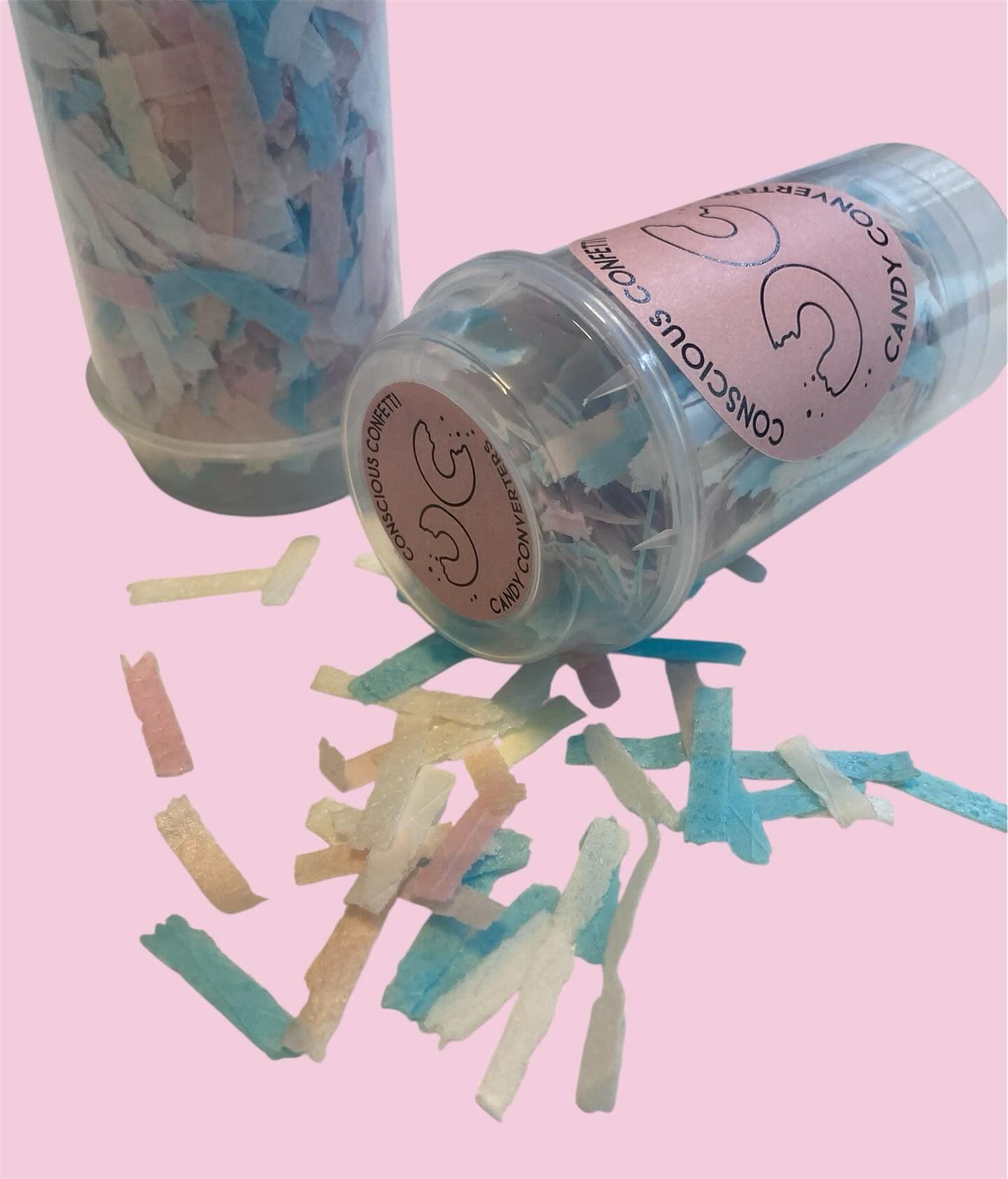
Candy Converters' Conscious Confetti is crafted from residual edible wafer paper from the food industry, with potato starch as the primary component. This blend makes it light, biodegradable, and fully water-soluble. Since the wafer paper is already food-grade and non-toxic, it's perfect for safe human contact and eco-applications. Its uniform thinness (0.3–0.6 mm) and light weight make it easy to flutter and quick to dissolve—without leaving any microplastics behind.
2. Could you describe the technical process behind converting candy wrapper waste into a functional, dissolvable material? What steps ensure material safety and stability?
The process begins with collection, inspection, and sorting of surplus edible wafer paper. These sheets are tested for water solubility, colourfastness, and fire safety. They are then cut into small (1–1.5 cm), lightweight pieces. As the colours are already embedded in the residual flow, there's no need for additional dyeing. The final confetti is packaged in recyclable or compostable materials like sugar-cane-based or kraft paper bags, balancing eco-credibility, moisture protection, and shelf-life.

3. The confetti dissolves entirely in water. How did you validate this feature for different environmental contexts like rain, seawater, or indoor cleaning scenarios?
Candy Converters confirmed its confetti dissolves in freshwater (warm and cold), rainfall, and seawater. Outdoor field tests by students showed complete disappearance after a single rain event. Though lab data isn’t public, multiple industry awards (Green Product Award, PSI Award, German Design Award) validate its performance and eco-claims.
4. How do you manage consistency in material quality when dealing with variable waste streams like surplus candy paper?
Variability in feedstock is addressed by embracing natural colour variations, which aligns with the brand's "pastel aesthetic". The team accepts minor differences while ensuring the core properties of solubility and safety remain intact.
5. When developing a product that avoids both plastic and fire hazards, what regulatory or performance standards did you prioritise, and how did those shape the formulation?
The team prioritised standards around biodegradability, compostability, flammability safety, colourfastness, and non-toxicity. These influenced their material choices, ensuring everything met EU food-contact and safety standards.
6. In terms of end-of-life, how have you tested the biodegradability of your confetti in different disposal scenarios: composting, landfill, urban runoff?
Tests showed the confetti dissolves completely in rain and drain water, leaving no residue. Under composting conditions, it breaks down aerobically. In landfill or low-oxygen settings, it still degrades, albeit more slowly, without releasing microplastics.
7. Could you walk us through your packaging material decisions? What trade-offs did you face when balancing compostability, shelf-life, and presentation?
The confetti is packaged in biodegradable or recyclable bags, typically made from sugar-cane bioplastic or kraft paper. The main design tension lies between moisture resistance and compostability. A balance was struck by using paper labels and plant-based inner linings, ensuring eco-friendliness without compromising shelf stability.

8. In scaling this innovation, what challenges have emerged in moving from artisanal to industrial-level production while maintaining environmental performance?
Challenges include securing consistent feedstock, maintaining production uniformity, and scaling without compromising brand ethos. Local Dutch production and short supply chains have helped reduce transport emissions and maintain transparency.
9. The colour-safe nature of your confetti is both aesthetic and practical. What considerations or treatments were necessary to achieve this property without relying on synthetic dyes?
Colour safety is achieved through food-grade pigments and starch encapsulation. Only EU-approved dyes are used. Tests confirmed no bleeding on fabric or flooring, even when wet. Minor sunlight fading is accepted in favour of a non-toxic formulation.